DID YOU KNOW? The difference between demineralised water and distilled water lies mainly in the purification process used to produce them. Demineralised Water is treated using processes – such as ion exchange resins, reverse osmosis or deionisation – which remove mineral salts and many impurities. Distilled Water, on the other hand, is obtained through distillation: a process involving the evaporation of water and the subsequent condensation of the vapour, removing minerals and contaminants almost entirely. Both are characterised by a high degree of purity and are used in technical, industrial and domestic settings, for example in equipment, laboratories or systems that require residue-free water. The choice between the two depends primarily on the specific application and the level of purity required.
PACKAGING
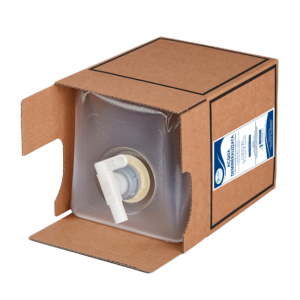
Demineralised Water packaged in 10-litre cubitainers, securely sealed with a security seal.
Why choose the cubitainer? It consists of a rigid cardboard box containing a flexible inner pouch. It provides protection from light and creates a barrier that prevents the liquid inside from coming into contact with the air – and therefore with bacteria and dust (even when being emptied). It is 100% recyclable and space-saving, as it folds flat when empty.